
When goals feel scattered, it’s often because they’re not anchored to the values that matter most. AI can help surface patterns in what motivates you, translate vague priorities into specific commitments, and highlight where time and energy aren’t matching what you care about. This guide walks through a practical, privacy-minded way to map values to goals, turn them into weekly actions, and keep your plan aligned as life changes.
Alignment is less about big declarations and more about repeated choices—what makes it onto your calendar, where your money goes, how you treat your health, and which relationships you nurture. When your day-to-day decisions consistently reflect your top values (not just your urgent tasks), you feel a steadier sense of purpose.
Misalignment often shows up as chronic guilt, overcommitment, frequent “should” statements, or goals that look impressive on paper but feel hollow once you’re chasing them. A simple definition that keeps things clear: values are the reasons; goals are the results; systems are the repeatable behaviors that connect them.
AI is especially useful when your thoughts are messy. It can organize brainstorms, summarize themes, and generate options you can accept, reject, or revise. That’s valuable when decision fatigue makes it hard to even name what matters, let alone prioritize it.
Another advantage is structure. AI can propose clean categories—relationships, growth, service, creativity, stability, health, freedom—so you’re not reinventing the wheel each time you reflect. It can also help you iterate quickly: answer → summarize → adjust → choose.
What AI cannot do is decide your values. It can reflect and reframe what you provide, but the meaning has to be yours. For grounding, it helps to remember that “values” are commonly defined as enduring beliefs about what is important and desirable; the APA Dictionary of Psychology offers a helpful reference point. And if you’re thinking about how goals connect to a broader sense of flourishing, the Stanford Encyclopedia of Philosophy’s entry on well-being provides a thoughtful overview.
Gather a week or two of real material: journal snippets, recent wins, resentments, “peak moments,” recurring worries, and what you keep postponing. These are strong signals because they’re tied to emotion, not just preference.
Ask AI to summarize recurring themes and propose 8–12 candidate values with plain-language definitions. You’re looking for words that feel like “yes, that’s it,” not words that sound aspirational but distant.
Select the values that matter most in your current season. Then write a short “proof statement” for each: how it shows up when you’re living it well. Proof statements prevent values from becoming vague slogans.
Many people get stuck because their values compete: ambition vs. rest, freedom vs. stability, service vs. solitude. Identify your conflict pairs and decide on one boundary per value that protects it in real life.
For each value, create 1–2 measurable goals for the next 90 days plus one identity-based habit (a small behavior that signals “I’m the type of person who…”). The 90-day horizon is long enough to matter and short enough to review without drifting.
| Value (plain language) | What it looks like weekly | 90-day goal example | One boundary to protect it |
|---|---|---|---|
| Health | 3 strength sessions + 7 hours sleep target | Complete 24 workouts in 8 weeks | No meetings before morning movement |
| Connection | 2 meaningful check-ins | Plan 6 friend/family meetups | Phone-free dinners 4 nights/week |
| Growth | 2 focused learning blocks | Finish one course + apply one project | Limit multitasking during deep work |
| Stability | Weekly money review + meal plan | Build one-month buffer | No impulse buys over a set amount |
A plan “sticks” when it respects your real capacity. Use three-layers planning to reduce overload:
If you want additional guidance on using AI responsibly, the NIST AI Risk Management Framework is a reputable overview of risk-aware AI use.
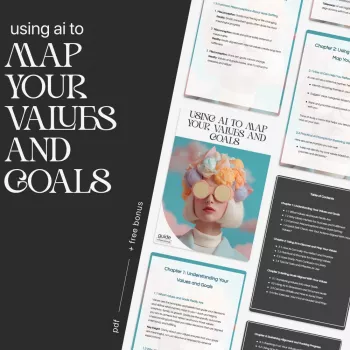
For a done-for-you framework, Using AI to Map Your Values and Goals (digital workbook download) supports values mapping, goal setting, and alignment check-ins in a format that’s easy to update each quarter.
If one of your core values is calmer family life, Stay Calm Within Mindful Parenting System – 4-in-1 Bundle for Parents can help translate “I want to be more patient” into concrete routines and tools. And if health goals are part of your map, Home Cardio Blast Checklist (instant digital download) is a simple way to keep workouts consistent without overplanning.
Yes—by summarizing themes from your experiences and preferences. Use it to generate candidate values, then choose and define the final set yourself with examples that prove each value.
Create a flexible 90-day goal and pair it with a weekly minimum habit. Add boundaries and review weekly so the goal serves the value rather than replacing it.
Name the conflict pair, decide which value leads in the current season, and set a maintenance minimum for the other. Revisit quarterly to rebalance.






Leave a comment