Must-Have Car Tools: A Practical Digital Maintenance Guide and Auto Repair Checklist for DIY Drivers
A reliable tool kit turns small car problems into quick fixes instead of stressful surprises. The difference usually isn’t “having every tool,” but having the right basics organized in a repeatable routine. A checklist-based approach helps keep safety steps, correct fastener sizes, and reassembly details from getting missed—especially when you’re working in a driveway, at night, or under time pressure.
If you want a simple system you can reference on your phone or print for the garage, the Must-Have Car Tools digital download guide and auto repair checklist groups core tools, safety gear, and common tasks into one practical workflow.
What “Must-Have” Really Means for Car Tools
- Coverage for common jobs: inspection, basic service, minor repairs, and roadside needs—without jumping straight into specialty equipment.
- Compatibility first: common fastener sizes, universal tools, and items that work across vehicle makes and model years.
- Risk reduction: safety equipment, stable lifting support, and torque accuracy matter more than “extra” tools.
- A checklist mindset: fewer forgotten steps, fewer stripped fasteners, fewer repeat trips to the parts store.
Core Hand Tools to Start With (and Why They Matter)
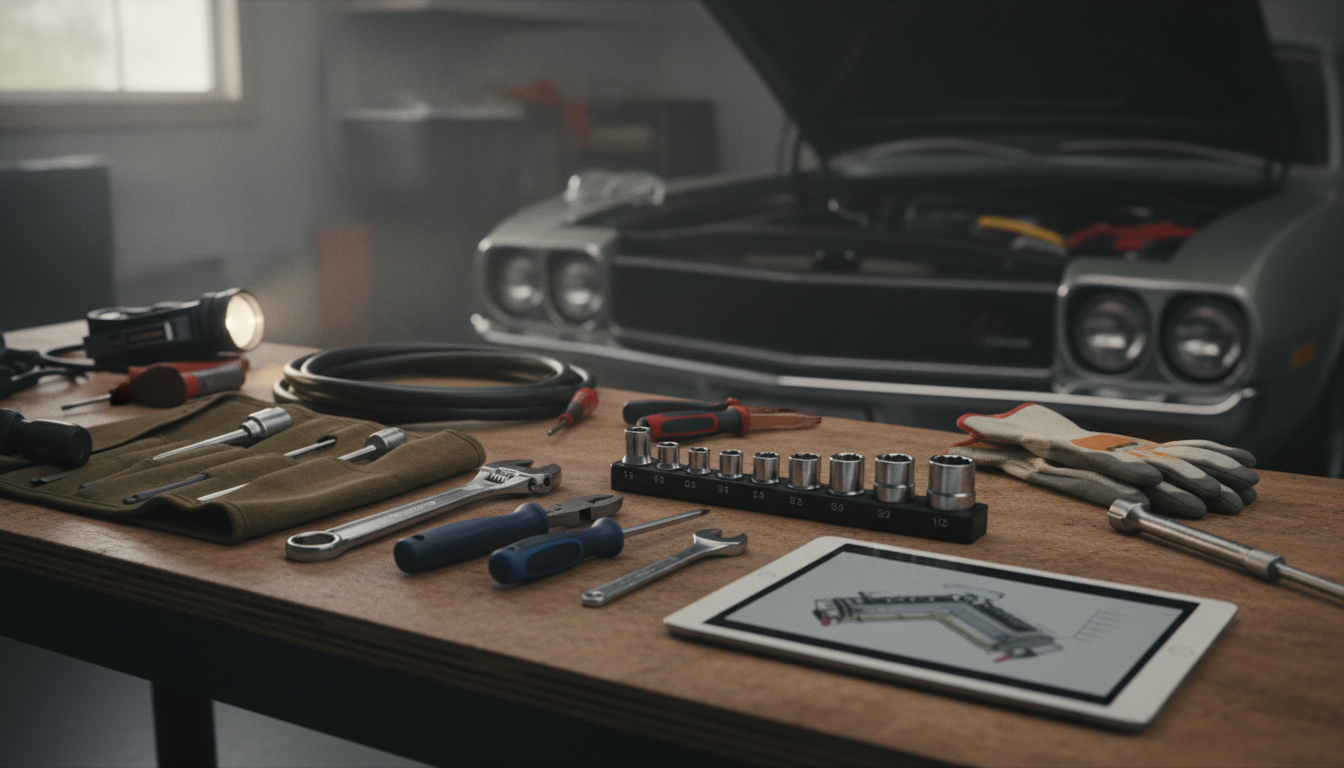
- Socket set and ratchets: Metric sizes cover most modern vehicles. Add extensions and a universal joint for tight engine-bay angles.
- Combination wrenches: A lifesaver when a ratchet won’t fit. Great for battery terminals, brake brackets, and accessory bolts.
- Screwdrivers and a bit driver: Phillips, flat, Torx, and hex bits handle everything from underbody clips to interior panels.
- Pliers set: Needle-nose, slip-joint, and locking pliers help with clamps, hoses, cotter pins, and stuck hardware.
- Trim removal tools: Prevent broken clips during cabin filter swaps, stereo work, and panel access.
- Work light/headlamp + magnetic pickup tool: Better visibility means fewer mistakes, and the pickup tool saves dropped bolts from disappearing forever.
Safety and Lifting Gear for DIY Maintenance
- Jack stands (rated for vehicle weight): Never rely on a jack alone when working underneath the vehicle.
- Wheel chocks: Stabilizes the car during lifting—especially on sloped driveways.
- Mechanic gloves and safety glasses: Sharp edges, debris, and fluids are part of the job; basic protection prevents common injuries.
- Torque wrench: Helps prevent over-tightening lug nuts and critical fasteners, supporting consistent reassembly.
- Fire extinguisher (automotive-rated) + basic first-aid kit: Smart additions for both garage storage and trunk readiness.
- Creeper or kneeling pad: Reduces strain and improves control when working low to the ground.
Consumables and Small Items That Save the Day
- Penetrating oil, brake cleaner, and shop towels: Penetrating oil helps with rusted bolts; brake cleaner cuts grime; towels keep surfaces and hands manageable.
- Zip ties, electrical tape, and spare fuses: Quick fixes for loose wiring, temporary securing, and simple electrical issues.
- Funnel, drain pan, and fluid transfer pump: Cleaner oil changes and top-offs, with less mess and less waste.
- Spare gloves, hand cleaner, and a parts tray: Keeps hands safer and prevents “mystery missing fastener” problems during reassembly.
- OBD2 scanner (basic): Speeds up diagnosis of check-engine lights and helps confirm issues before you buy parts.
Quick Checklist: Match the Tool to the Job
Building confidence is easier when each job has a standard “grab list.” Start with these practical pairings, then expand only when a specific task demands it:
- Oil change: correct socket for drain plug, filter wrench (if needed), drain pan, funnel, gloves, torque wrench
- Tire swap/rotation: breaker bar or lug wrench, jack and stands, chocks, torque wrench, tire pressure gauge
- Battery service: wrenches for terminals, brush/cleaner, gloves and eye protection
- Brake inspection: wheel tools, light, caliper tools (as needed), brake cleaner, torque wrench
- Cabin/engine air filter: screwdriver/bit set, trim tools, light
Common DIY Tasks and the Tools That Make Them Easier
| Task |
Minimum tools |
Nice-to-have upgrades |
Common mistakes to avoid |
| Change a tire / rotate tires |
Jack, jack stands, chocks, lug wrench |
Breaker bar, torque wrench, tire pressure gauge |
Under/over-torquing lug nuts; lifting on unstable ground |
| Oil and filter change |
Socket for drain plug, drain pan, funnel |
Filter wrench, torque wrench, fluid pump |
Overtightening drain plug; spilling hot oil |
| Replace wiper blades |
No tools (usually) |
Gloves, glass cleaner |
Forcing the arm; scratching windshield |
| Replace battery |
Wrenches for terminals |
Terminal brush, memory saver, gloves/eye protection |
Reversing polarity; loose connections |
| Read check-engine light |
OBD2 scanner |
App-based scanner with live data |
Ignoring codes without confirming symptoms and basics |
Using the Digital Maintenance Guide Like a System
For tire-related safety basics and inspection tips, the NHTSA Tire Safety page is a solid reference. For broader maintenance planning, the Car Care Council vehicle maintenance checklist is also a helpful overview.
Digital Download: Must-Have Car Tools Guide and Auto Repair Checklist
Pair your maintenance routine with a cleaning routine to keep your car feeling fresh between services: Car cleaning hacks checklist for a spotless interior and exterior.
FAQ
What are the most essential tools to keep in the car for emergencies?
Cover roadside basics like a flashlight, gloves, tire gauge, a compact socket/driver set, jumper cables or a jump starter, a basic first-aid kit, and zip ties/tape. Adjust for your vehicle and climate, and check any local requirements for emergency gear.
Do beginners really need a torque wrench?
A torque wrench improves safety and consistency on wheels and other critical fasteners, helping prevent stripped threads and uneven clamping. A reliable click-type torque wrench is a practical starting point for most DIY drivers.
Which is better for DIY repairs: a full tool chest or a focused starter kit?
A focused starter kit usually wins because it matches the jobs most people actually do, without paying for rarely used specialty tools. Expand only when a specific repair calls for something new, and use a checklist to avoid duplicates.
Recommended for you






Leave a comment