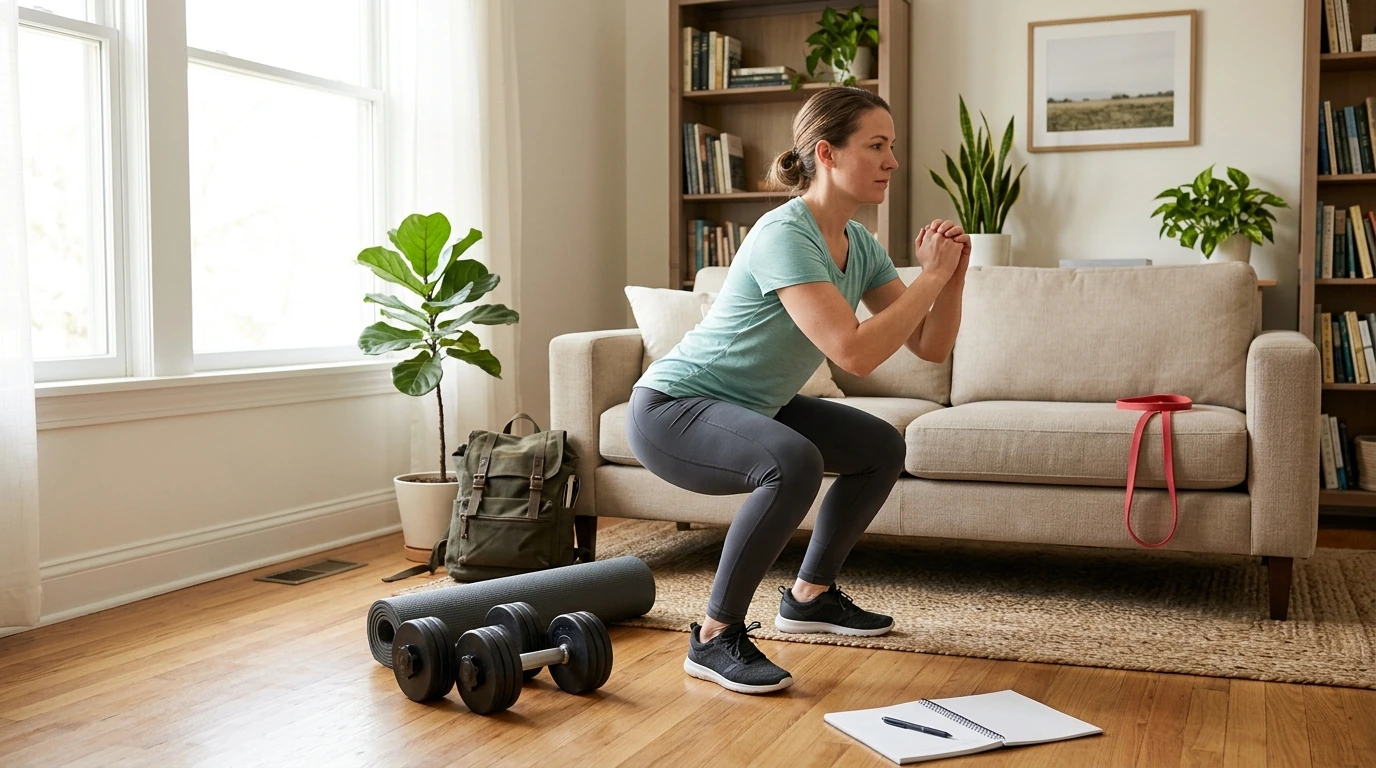
A strong, capable body can be built at home with a few core movements, simple progression rules, and a repeatable weekly schedule. The goal is to train consistently, move well, and make small upgrades over time—whether you’re starting from zero or ready to level up with tougher variations and added load.
A small, consistent routine beats a complicated plan done once a month. Home strength training works best when it covers a few key patterns repeatedly and progresses gradually.
If you want a ready-to-follow roadmap with progressions already organized, Strength Training at Home Made Simple | Easy Home Workout Guide for Beginners to Advanced Fitness pairs well with basic tracking (date, exercise variation, sets, reps, difficulty note).
A short warm-up and clean reps are the fastest way to stay consistent. Aim for 5–8 minutes before working sets:
For most exercises, use controlled reps: about 2 seconds down, a brief pause, and 1 second up. Maintain joint “stacking” (wrists under shoulders in planks/push-ups, knees tracking over toes in squats/lunges, neutral spine during hinges). Most sets should end 1–3 reps before form breaks.
| Pattern | Common mistake | Simple fix cue |
|---|---|---|
| Squat/Lunge | Knees collapsing inward | Press knees gently out; keep weight mid-foot |
| Hip hinge | Rounding lower back | Push hips back; keep ribs down and spine long |
| Push | Elbows flaring straight out | Aim elbows ~30–45° from body |
| Pull | Shrugging shoulders to ears | Pull shoulder blades down and back first |
| Core | Sagging hips in plank | Tuck pelvis slightly; squeeze glutes |
Home training gets results when it’s measurable. Keep it simple:
For general health guidelines that support strength training routines, see the CDC recommendations for adult physical activity.
Schedule: Monday/Wednesday/Friday (or any 3 non-consecutive days). Alternate Workout A and B each session.
How to run it: Week 1 = A/B/A. Week 2 = B/A/B. Rest 60–120 seconds between sets and prioritize smooth technique over speed.
Schedule example: Upper/Lower split (Mon Upper, Tue Lower, Thu Upper, Fri Lower). Keep one rest day between lower sessions if soreness reduces movement quality.
To make progress without fancy equipment, add difficulty using slower eccentrics (3–4 seconds down), longer ranges of motion, or more external load. For a deeper overview of resistance training’s benefits and best practices, the American College of Sports Medicine is a helpful reference.
On weeks when you want to add conditioning without guessing, pair strength days with a simple cardio routine from the Home Cardio Blast Checklist | Instant Digital Download for Effective Cardio Workouts at Home.
If you want a step-by-step plan with clear progressions from beginner to advanced, use Strength Training at Home Made Simple | Easy Home Workout Guide for Beginners to Advanced Fitness. It’s especially effective when paired with one habit: record the date, the exercise variation used, your sets and reps, and a quick difficulty note.
Set a simple 4-week target: complete 12 sessions, improve at least two movements (more reps, harder variation, better tempo), and keep rest days consistent. For additional background reading on strength training basics, NIH MedlinePlus offers a clear overview.
Two to three non-consecutive days per week is ideal for most beginners, because it provides enough practice while leaving room for recovery. After 4–6 weeks of steady progress, a fourth day can work well if soreness and energy stay manageable.
Yes—bodyweight strength improves when you progressively increase the challenge using reps, tempo, range of motion, leverage changes, and single-limb variations. When progress slows, adding a band or a loaded backpack can help you keep overloading safely.
A resistance band set and a simple way to add load (like a sturdy backpack or adjustable dumbbells) cover the most needs for the lowest cost. If possible, add a pull option (band rows with a door anchor) and a basic mat for comfort.






Leave a comment