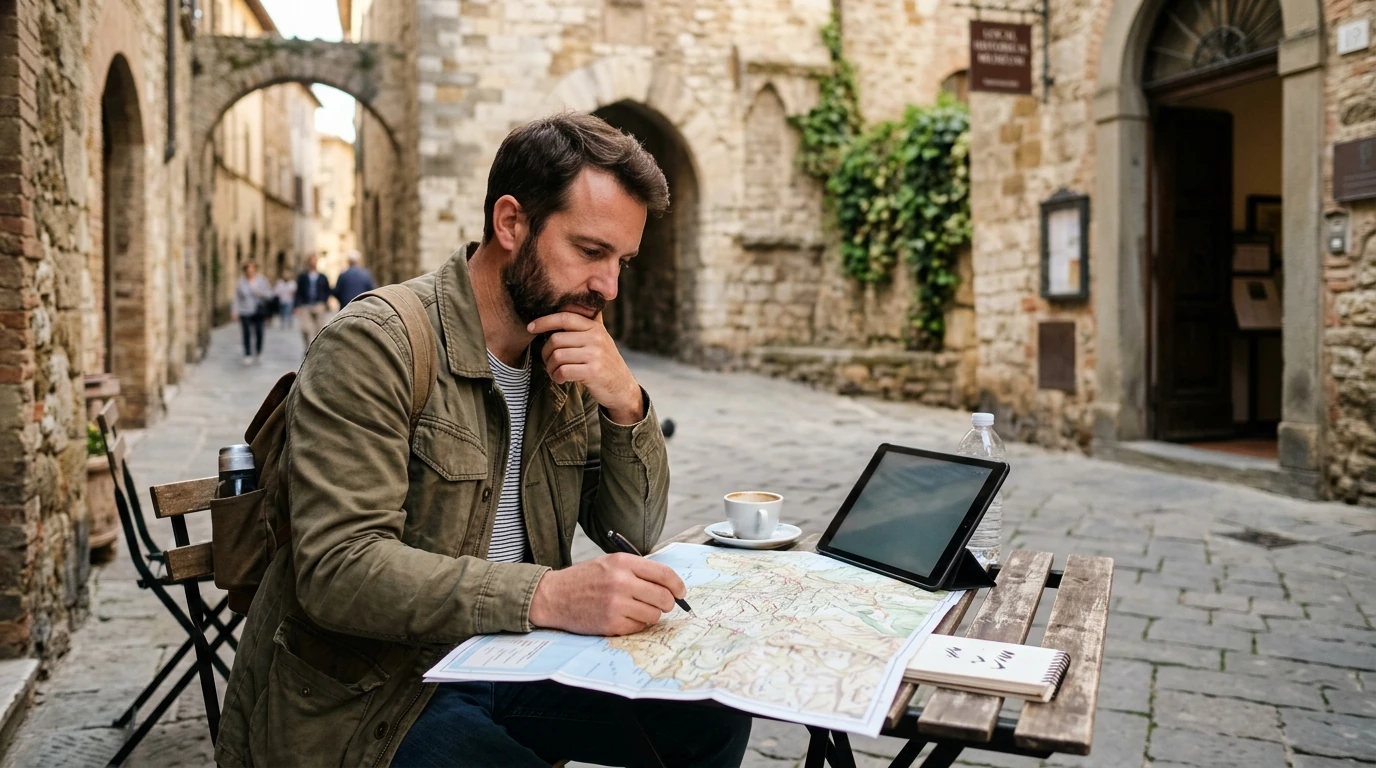
Historical travel gets far more rewarding when planning moves past headline landmarks and into layered timelines, local context, and overlooked sites that still shape the present. With the right workflow, AI can help match personal interests to specific eras, surface lesser-known places, and turn scattered notes into a practical itinerary—while leaving space for the best kind of surprise: what you notice once you’re actually there.
Before searching for destinations, define what “history-rich” means for you. A simple profile helps AI make recommendations that feel tailored rather than generic.
If you want a structured companion you can reuse trip after trip, Using AI to Discover Destinations Rich in History: An Ultimate Guide to Exploring Historical Travel with AI turns this idea into a repeatable system—from choosing destinations to organizing daily “chapters” of exploration.
Once you have a destination (or a short list), the fastest way to deepen the experience is to search beyond “top 10” attractions and instead target the places that explain how a city or region worked.
| Goal | Prompt to use | What to verify |
|---|---|---|
| Find overlooked sites | Suggest 12 lesser-known historical sites within 90 minutes of [city], focused on [theme/era]. Include why each matters and best time of day to visit. | Opening hours, seasonal closures, access routes |
| Build context fast | Give a concise timeline of [region] from [year] to [year] and list 8 places where each turning point can be seen today. | Historical accuracy, dates, source credibility |
| Connect sites into a narrative | Create a 3-day itinerary in [destination] that follows the story of [empire/period] with walking clusters and transit notes. | Distances, realistic pacing, ticket requirements |
| Avoid tourist traps | Which attractions in [destination] are frequently overrated for history-focused travelers, and what are better alternatives? | Bias, local reviews, current renovations |
Itineraries feel more meaningful when sites connect into an arc, not a checklist. Instead of cramming everything in, use AI to help you build a narrative structure that you can actually follow on foot.
For travelers building walking-heavy days, a simple conditioning routine can make long museum-and-ruins schedules more comfortable. A lightweight option to keep planning practical is Home Cardio Blast Checklist | Instant Digital Download for Effective Cardio Workouts at Home.
For authoritative starting points, check the UNESCO World Heritage Centre and ICOMOS. When you’re building museum-heavy days, museum sites (for example, The British Museum) are often the fastest way to confirm hours, access rules, and exhibit notes.
If your historical trip includes road segments (especially to secondary towns and rural sites), keeping your vehicle ready for long days helps avoid avoidable stress. Car Cleaning Hacks to Keep Your Ride Fresh – Digital Checklist is an easy add-on for travel prep and post-hike cleanup.
| Step | Input | Output |
|---|---|---|
| 1) Define themes | Era + topics + constraints | A “history profile” for trip matching |
| 2) Shortlist destinations | Profile + region options | Ranked list with reasons and tradeoffs |
| 3) Build daily chapters | Top sites + map radius | Clustered itinerary with pacing |
| 4) Verify essentials | Official sources | Accurate times, tickets, and closures |
| 5) Prepare field notes | Itinerary + context prompts | Offline briefs and observation cues |
Use a chat-based assistant to generate themes, timelines, and shortlists, then rely on mapping apps to validate routing and timing, plus translation tools for signage. Always verify key facts and logistics using official museum pages and recognized heritage organizations.
It can surface secondary cities near major attractions, micro-sites within famous neighborhoods, and theme-based angles like trade networks or women’s history. Confirm each suggestion through museum websites, heritage lists, and current local reviews before adding it to a day plan.
Cross-check dates, names, and claims against official sources, and ask for notes on what scholars debate when evidence is uncertain. Also confirm practical details—hours, reservations, tour languages, and closures—so the plan remains accurate on the ground.






Leave a comment