
A tidy craft space isn’t about perfection—it’s about being able to start creating quickly, find what you need, and avoid buying duplicates. The easiest way to get there is a repeatable system: reset, sort, decide, store, label, then maintain. When the steps stay the same, organizing stops feeling like a big “someday” project and becomes a quick, satisfying reset you can actually keep up with. For more guidance, see Craft Room Organization Tips (+ FREE Craft Room Printables!).
Before you try to “organize,” set up a short sprint that keeps you moving and prevents distraction. For further reading, see Take Stock of All Your Craft Supplies | A Free Printable.
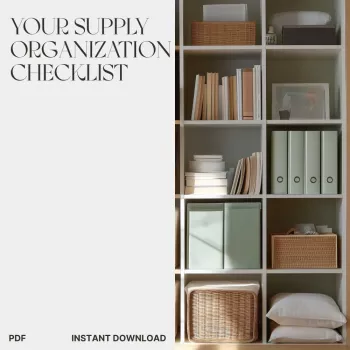
If you like having a step-by-step guide in front of you, Your Supply Organization Checklist (printable digital download) makes it easy to move through the reset without second-guessing what to do next.
The fastest organizing systems mirror real life. Instead of getting overly specific, start broad and then narrow only where it helps.
| Category | What goes inside | Best storage style |
|---|---|---|
| Cutting tools | Scissors, craft knives, blades, cutting mats | Lidded bin + small blade case |
| Adhesives | Glue sticks, liquid glue, tape runners, double-sided tape | Small caddy near workspace |
| Paper & cardstock | Cardstock, scraps, patterned paper, stickers | Vertical files + scrap envelope |
| Paint & ink | Acrylics, watercolor, ink pads, brushes | Drawer organizer + brush cup |
| Sewing notions | Thread, needles, pins, buttons, zippers | Compartment box + thread rack |
| Yarn & fiber | Yarn, hooks, needles, stitch markers | Clear bin + project bags |
| Vinyl/plotter | Vinyl rolls, weeding tools, transfer tape | Vertical bin + tool pouch |
Decision fatigue is what derails most organizing. Use a small set of rules, and let the container do the arguing.
For a decluttering mindset that works well with craft “miscellaneous,” the KonMari approach to komono can be a helpful reference point: KonMari Method basics.
The best storage makes putting things away the path of least resistance. Aim for “easy to return,” not “pretty for photos.”
If you need layout inspiration for shelves, carts, and small-space solutions, The Spruce Crafts has a wide range of practical craft-room ideas you can adapt to a closet, corner desk, or rolling cart.
Grab Your Supply Organization Checklist | Printable Craft Supply Checklist when you want a simple structure you can repeat anytime your supplies start to sprawl.
If you’re building a “checklist habit” across different routines, you may also like Car Cleaning Hacks to Keep Your Ride Fresh – Digital Checklist and Home Cardio Blast Checklist | Instant Digital Download for quick, done-in-minutes resets.
Create zones inside one container system—a tote, rolling cart, cabinet, or shelf—then keep a small daily-reach caddy for the tools you use every session. Use vertical storage wherever possible, and stick to container boundaries so each category can’t outgrow its space.
Sort scraps by size and purpose (tiny embellishment pieces, “card front” pieces, and larger sheets), and limit each group to one container. Envelopes or file pockets make it easy to flip through, and a monthly purge or project-bundle session prevents slow buildup.
Type is usually fastest for finding tools, refilling consumables, and cleaning up quickly. Color can work well for visual materials like paper, vinyl, or embroidery floss, so a hybrid approach often wins: type for tools/adhesives, and color within a single material category.






Leave a comment