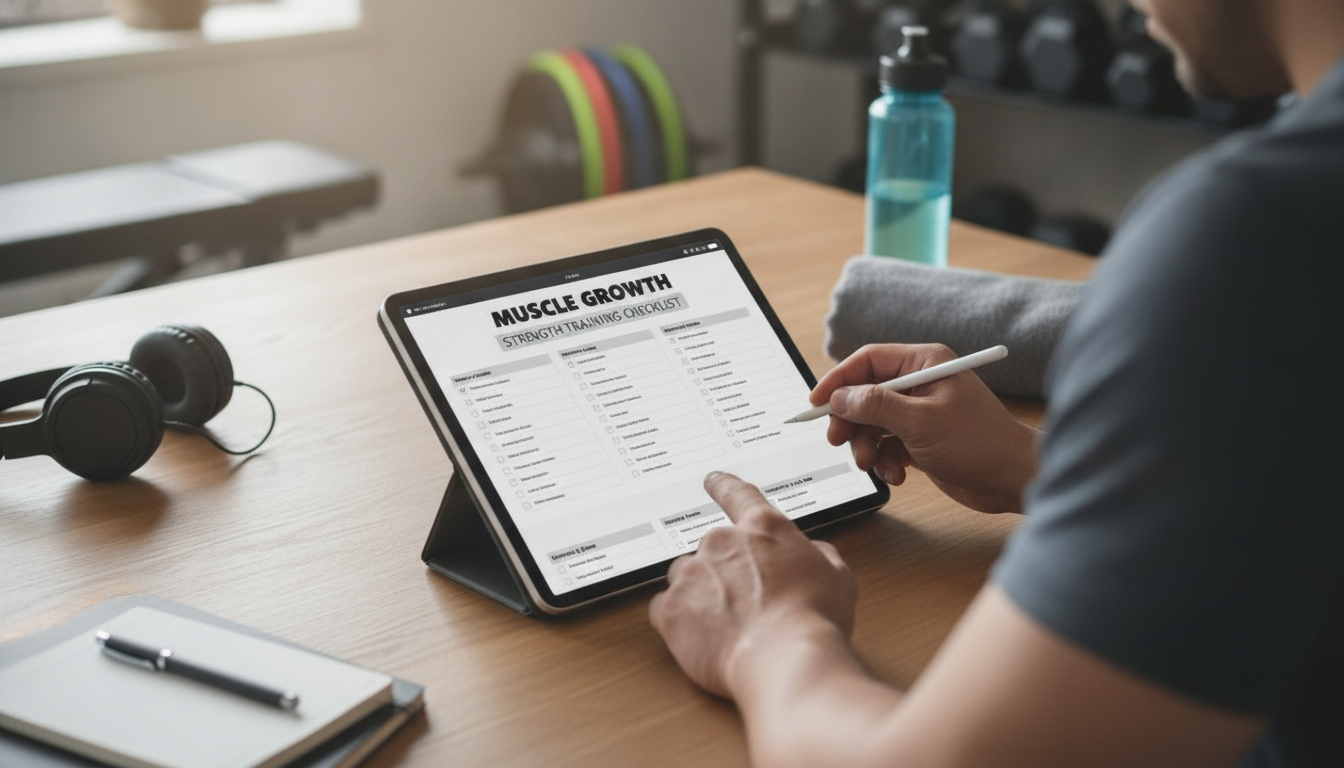
Muscle Growth Strength Training Checklist: A Step-by-Step System for Building Muscle
Building muscle gets simpler when the essentials are organized into a repeatable routine. A checklist turns “train harder” into clear weekly targets for training, nutrition, recovery, and tracking—so progress is driven by consistency instead of guesswork. Use the system below to plan your week, execute your sessions, record what matters, and make small adjustments that add up to bigger lifts and more size.
What a Muscle-Building Checklist Solves
- Turns vague goals into weekly actions: exercises, sets, reps, loads, and recovery targets.
- Prevents common plateaus caused by inconsistent effort, random exercise selection, or poor progression.
- Creates a simple feedback loop: plan → train → record → adjust.
- Keeps priorities clear when time is limited: big lifts first, accessories second, finish with mobility.
Set Up Your Foundation: Goals, Schedule, and Baselines
Before adding sets or swapping exercises, lock down a short training “season” with boundaries. Most lifters do best with an 8–12 week focus so decisions are easy and progress is measurable.
- Pick a primary goal for the next 8–12 weeks: strength emphasis (lower reps/heavier loads) or hypertrophy emphasis (moderate reps/higher volume).
- Choose a realistic weekly schedule (2–5 days) and commit to specific training days and session length.
- Record baselines for key lifts (or estimated 1RM), body weight, and a simple measurement set (waist, chest, arms, thighs).
- Select a training split that matches availability: full-body (2–3 days), upper/lower (4 days), or push/pull/legs (5–6 days).
If you’re new to structured lifting, keep exercise selection stable for at least 6–8 weeks. Your “program” works best when you can compare sessions apples-to-apples and spot real improvements.
Training Checklist: The Non-Negotiables for Growth
- Prioritize compound lifts each session (squat/hinge/push/pull/carry patterns) before isolation work.
- Use progressive overload: add reps, load, sets, or improve technique while keeping effort high.
- Train close to failure on key sets while maintaining form (leave ~0–3 reps in reserve most of the time).
- Balance weekly volume per muscle group; increase gradually if recovery and performance stay strong.
- Warm up with a short general warm-up plus specific ramp-up sets for the first lift.
- Include consistent rest periods: longer for heavy compounds, shorter for accessories.
Weekly Strength Training Checklist (Example Targets)
| Item |
Target |
How to Track |
| Training days |
3–5 sessions/week |
Calendar + completion checkboxes |
| Hard sets per muscle group |
8–16 sets/week (adjust by experience) |
Log sets by muscle group |
| Progression |
1 small improvement per lift weekly |
Add 1 rep, 2–5 lb, or 1 set |
| Compound lifts |
2–4 per week per movement pattern |
Exercise list + frequency |
| Effort |
Most work sets at RIR 0–3 |
Note RIR next to each set |
| Deload |
Every 6–10 weeks as needed |
Reduce volume/intensity for 1 week |
Progression Rules That Keep You Moving Forward
Plateaus usually come from progression that’s too aggressive (burnout, aches, sloppy reps) or too vague (doing “more” without a plan). These rules keep momentum without grinding you down.
- Double progression: stay within a rep range (e.g., 6–10) and increase load only after hitting the top end for all sets.
- Small jumps beat big jumps: increase load conservatively to protect form and joints.
- Keep one variable stable: if load goes up, avoid increasing sets in the same week for the same lift.
- Use a minimum effective dose first; add volume only when progress slows for 2–3 weeks.
- Plan a deload when performance drops, soreness lingers, sleep worsens, or motivation tanks.
For evidence-based guidance on how progression models work in resistance training, the ACSM Position Stand on progression is a helpful reference point.
Nutrition Checklist for Muscle Gain (Without Guesswork)
- Calories: aim for a modest surplus to support growth while limiting unnecessary fat gain.
- Protein: hit a consistent daily target, spread across 3–5 meals.
- Carbs: prioritize around training to support performance and recovery.
- Fats: keep a steady baseline for hormones and satiety; avoid extremely low intakes.
- Hydration and sodium: support training performance, pumps, and recovery.
- Consistency beats perfection: weekly averages matter more than single meals.
If you want a grounded overview of protein basics (what it does and how much people typically need), see the NIH Office of Dietary Supplements protein fact sheet.
Recovery Checklist: Make Growth Possible Between Sessions
Technique and Safety Checks
For coaching education and lifting resources, the NSCA training articles library is a solid place to learn standard cues and common technique fixes.
Tracking: The Simplest Data That Predicts Results
Printable Support: Use a Ready-Made Checklist
FAQ
How many days per week are needed to build muscle effectively?
Most people can build muscle training 2–5 days per week, as long as weekly volume and effort are consistent. Full-body training works well for 2–3 days, upper/lower fits 4 days, and push/pull/legs is often best when you can train 5+ days.
How long does it take to see muscle growth from strength training?
Strength often improves within a few weeks due to better technique and coordination, while visible muscle growth typically takes several weeks to a few months. Consistent training, enough calories and protein, and solid sleep tend to speed up noticeable changes.
Should cardio be avoided while trying to gain muscle?
No—moderate cardio can coexist with muscle gain if recovery and calories are handled well. Keep most cardio easy to moderate, place hard cardio away from heavy leg training when possible, and ensure you’re still eating enough to support training performance.
Recommended for you







Leave a comment